In a dense campus, cognitive LLM-Agents drive collective time–place–mode–route decisions to quantify how information strategies redistribute queues and road loads and shave peaks at the population level.
Research Background & Value Link to heading
- Population view: unify chain decisions for thousands during peaks, measuring aggregate space use and peak pressure.
- Interpretability: per-decision rationales with provenance enable causal tracing from individuals to the crowd.
- Actionability: compare global vs. beaconed information to quantify reductions in queue incidents and flow variance σ.
Research Methodology Link to heading
- Decision framework: four loosely coupled choices—departure time, dining destination, travel mode, and route—coordinated end-to-end. Each step carries over short-term memory (STM) and prior-step environment snapshots, emits transparent rationales, and remains traceable at the individual level and aggregable at the population level.
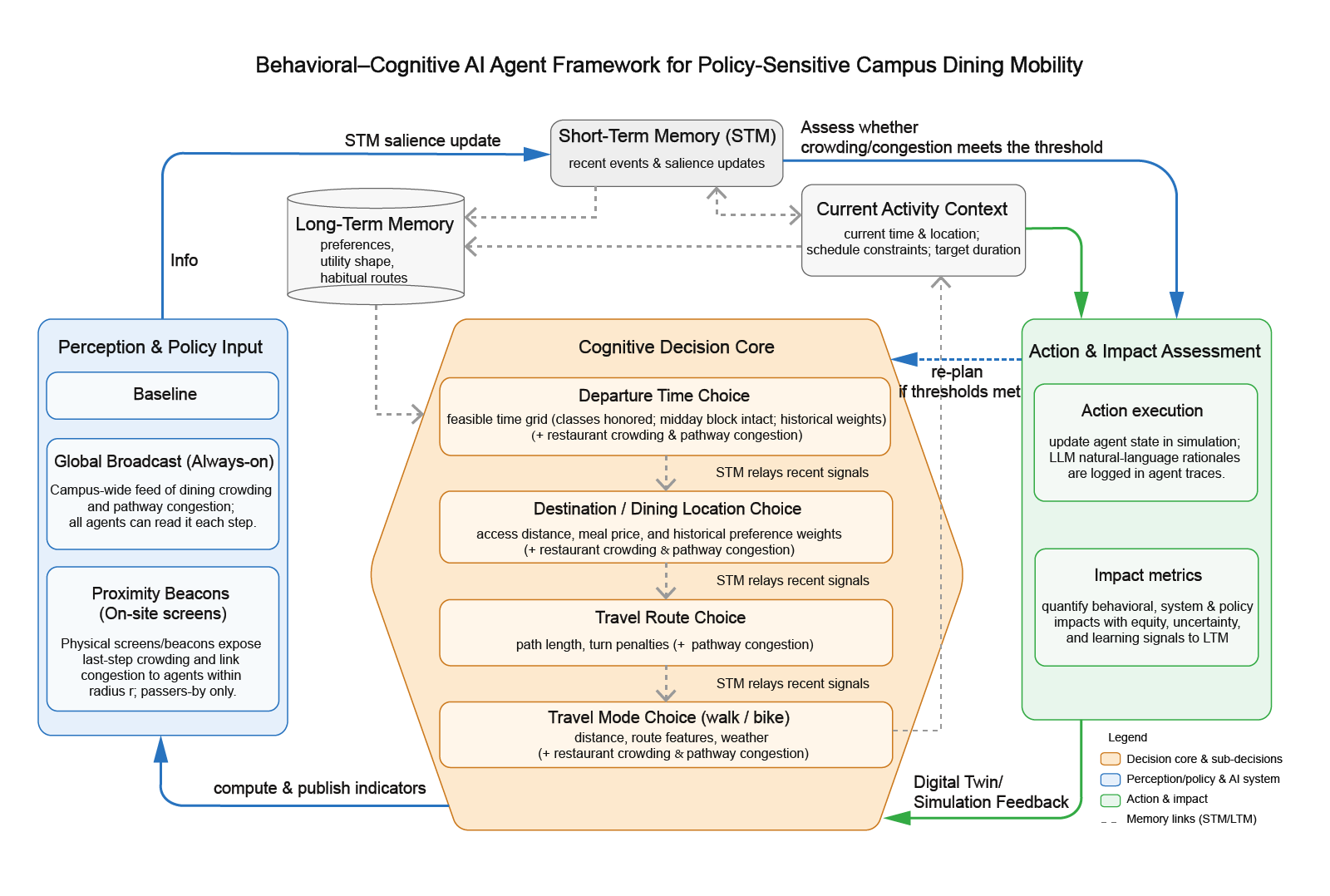
- Memory & sensing: a sticky memory formed by a long-term preference summary plus recent events incrementally assimilates preferences over distance, price, crowding, and road load. When information strategies are enabled, dining-crowding and road-congestion enter the LLM-Agent as previous-step snapshots (≈5 minutes earlier), serving as contextual priors for the current decision.
- Prompt–data contract:
Aspect Meaning Example prompt phrase (decision) Joint trade-offs (generic) No fixed priority; weigh time, distance/price, preferences, crowding/congestion, and context together “Consider all signals jointly with no fixed priority.” (all decisions) Semantics & provenance (generic) Crowding/congestion are previous-step snapshots; unknown ≠ zero; provenance must be tagged in reasons “Crowding/road info are previous-step snapshots; unknown ≠ zero; tag provenance, e.g., [crowd_provenance: global_prev_step] / [road_provenance: beacon_prev_step].” (all) Fairness & explainability (generic) Avoid unsupported identity claims; provide traceable, aggregable rationales “Fairness: avoid unsupported identity claims; provide transparent reasoning.” (all) Salience updates (generic) Apply small preference adjustments as sticky-memory tuning rather than hard rules “Apply small salience adjustments in [-0.15, 0.15] as gentle memory updates.” (all) Feasibility & time grid (departure) Choose within the allowed grid under class boundaries; prefer contiguous feasible blocks “Choose from the allowed time grid under class constraints; prefer a contiguous block around the target length.” (departure) Tie-breaking under near-equivalence (departure) Use the shortlist as a soft tie-breaker; maintain stochastic consistency if needed “When options are close, use the shortlist as a soft tie-breaker with a consistent stochastic token.” (departure) Time pressure & preferences (place) Balance distance, price, personal preferences, and time pressure; be conservative under clearly high crowding “Balance distance, price, preferences, and time pressure; be conservative under clearly high crowding unless explicitly justified.” (place) Route features & weather (mode) Trade off distance, route length/congestion/turns, weather, and biking overhead; reduce exposure under high congestion “Trade off distance, route features (length/congestion/turns), weather, and biking overhead; under high congestion, reduce exposure.” (mode) Length–congestion–turns (route) Jointly optimize total length, congestion (with coverage ratio), and turning complexity; avoid overconfidence under unknowns “Balance total length, known congestion (and coverage ratio), and turns; avoid overconfidence when congestion is unknown.” (route)
Study Area & Data Link to heading
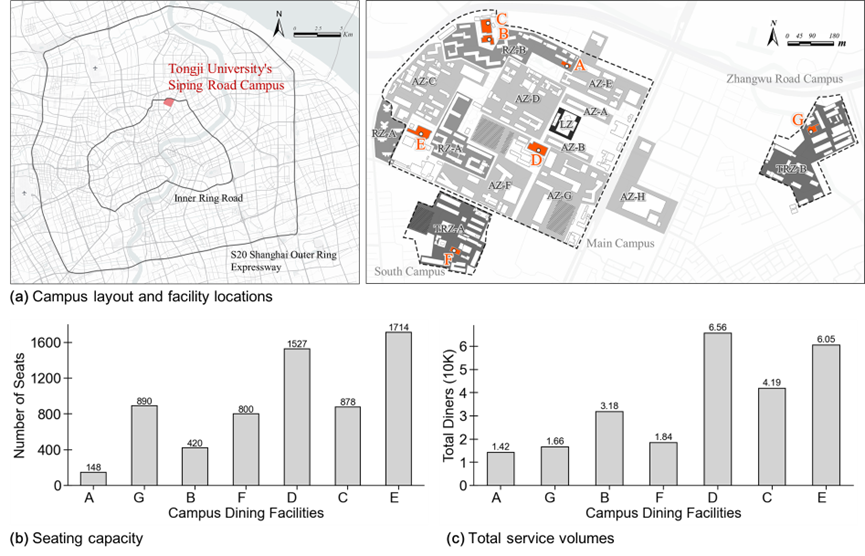
- Area: The empirical setting is Tongji University’s Siping Road Campus in Shanghai (100.98 ha; 31,653 users), a high-density campus with seven dining facilities and 16 functional zones.
- Data: Data comprise 21 weekdays of Campus Smart Card System logs from May 2023 (~6.14M records; ~27,800 diners with ~250k lunch transactions, 10:00–13:30), supplemented by 198 behavioral-preference surveys capturing dining duration, strategy acceptance, information willingness, and adjustment tolerances.
Usage & Scenarios Link to heading
Usage & Workflow Link to heading
Configure information (global/road/beacons x-y-r) → run collective simulation → inspect map/curves/logs → export evaluation HTML and playback.
Use Cases Link to heading
Embed information interventions and demand-side policies (e.g., staggering, mode/route guidance) into an agent-based behavioral simulation to quantify impacts on congestion exposure, travel-time loss, accessibility, and equity; future extensions will cover supply-side scenarios (e.g., dynamic pricing, pop-up takeaway stations) to enable integrated policy appraisal and the estimation of welfare/elasticity indicators (e.g., VOT, consumer surplus, demand elasticities).
Core Conclusions Link to heading
Mechanism Finding Link to heading
LLM-Agent log excerpts (table summarizes decisions across information scenarios).
| Agent | Scenario | Rationale |
|---|---|---|
| 22230854542 | NONE | Depart 11:50; Place Beiyuan_107; Mode walk; selects a contiguous 30-min block in the allowed grid; distance & existing preference dominate; UNKNOWN crowding is not assumed low. |
| 22230854542 | GLOBAL | Depart 11:50; Place Xiyuan_203; Mode walk; global snapshot shows rising crowding at Beiyuan (11:50–12:00) ⇒ lateral switch to a similar-distance window; 30-min integrity preserved. [prov: global_prev_step] |
| 22232494942 | NONE | Depart 11:10; Place Beiyuan_105; Mode walk; leaves earlier to avoid the 11:30 class-end surge; feasible in the time grid with lowest walking cost. |
| 22232494942 | GLOBAL | Depart 11:20; Place Beiyuan_201; Mode walk; global info indicates higher crowding for 11:10–11:20 ⇒ shift 10 min within grid and switch to an adjacent window, still satisfying continuity and pre-class constraints. [prov: global_prev_step] |
| 222310001012 | NONE | Depart 12:00; Place Xiyuan_203; Mode walk; balances noon preference and distance; UNKNOWN crowding not treated as low. |
| 222310001012 | GLOBAL | Depart 12:00; Place Xiyuan_205; Mode walk; global snapshot: growing queue at 203 while 205 slightly lower ⇒ micro-switch within the same hall to cut wait, preserving departure time & block integrity. [prov: global_prev_step] |