We develop a space–time association model that parameterizes working hours as traffic pulses. Intelligent optimization yields coordinated staggering strategies across cross-river systems, minimizing total system travel time and dynamically balancing network loads.
Research Background & Value Link to heading
- Paradigm Shift: Moving beyond traditional traffic engineering, this research elevates congestion management to demand-side space–time structure governance, offering a fundamental solution based on temporal allocation.
- Behavioral Modeling: Utilizing high-resolution big data, we build a Structure–Behavior Coupling Model to quantitatively decouple how functional layouts shape individual trip behavior, providing a mechanistic foundation for policy modeling.
- Policy Value: Delivering proactive policy guidance, the work supports cooperative optimization and sustainable development, maximizing network efficiency under equity principles.
Research Methodology Link to heading
- Behavioral Parameterization: Utilizing big data, each commuting flow is abstracted into a Gaussian distribution (traffic pulse) with adjustable mean (μ) and temporal elasticity (σ).
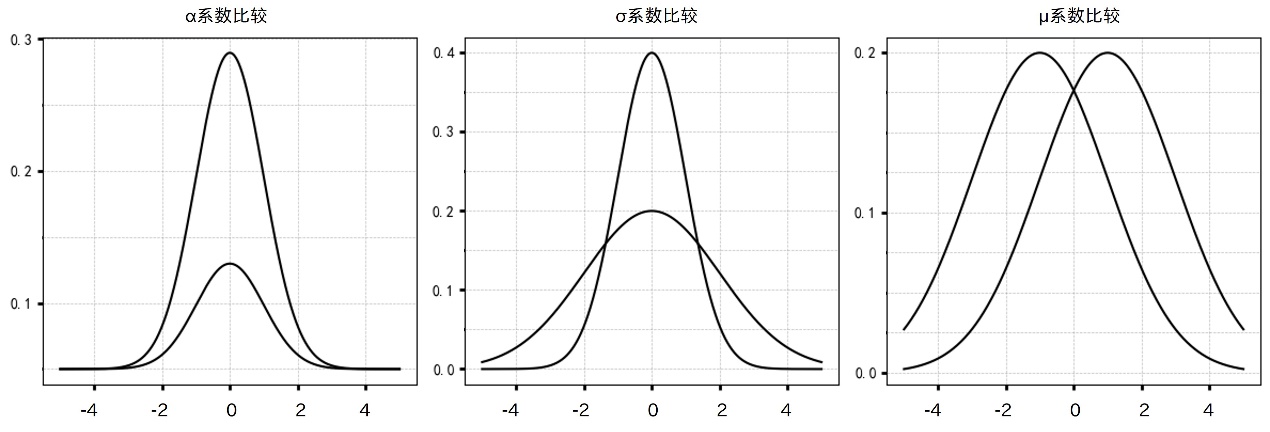
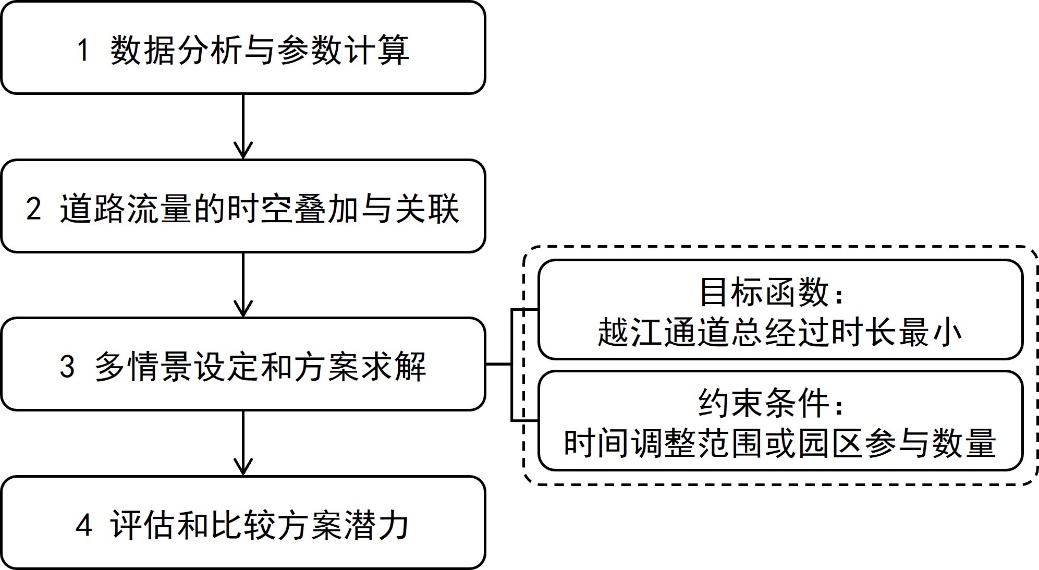
- Space–Time Overlap & Association: Pulses from all functional areas are superimposed across all channels; shared parameters establish network association, ensuring single-point adjustments feed back system-wide.
- Intelligent Solution: The objective is to minimize total system travel time by iteratively searching for the best coordinated time-staggering combination.
Study Area & Data Link to heading
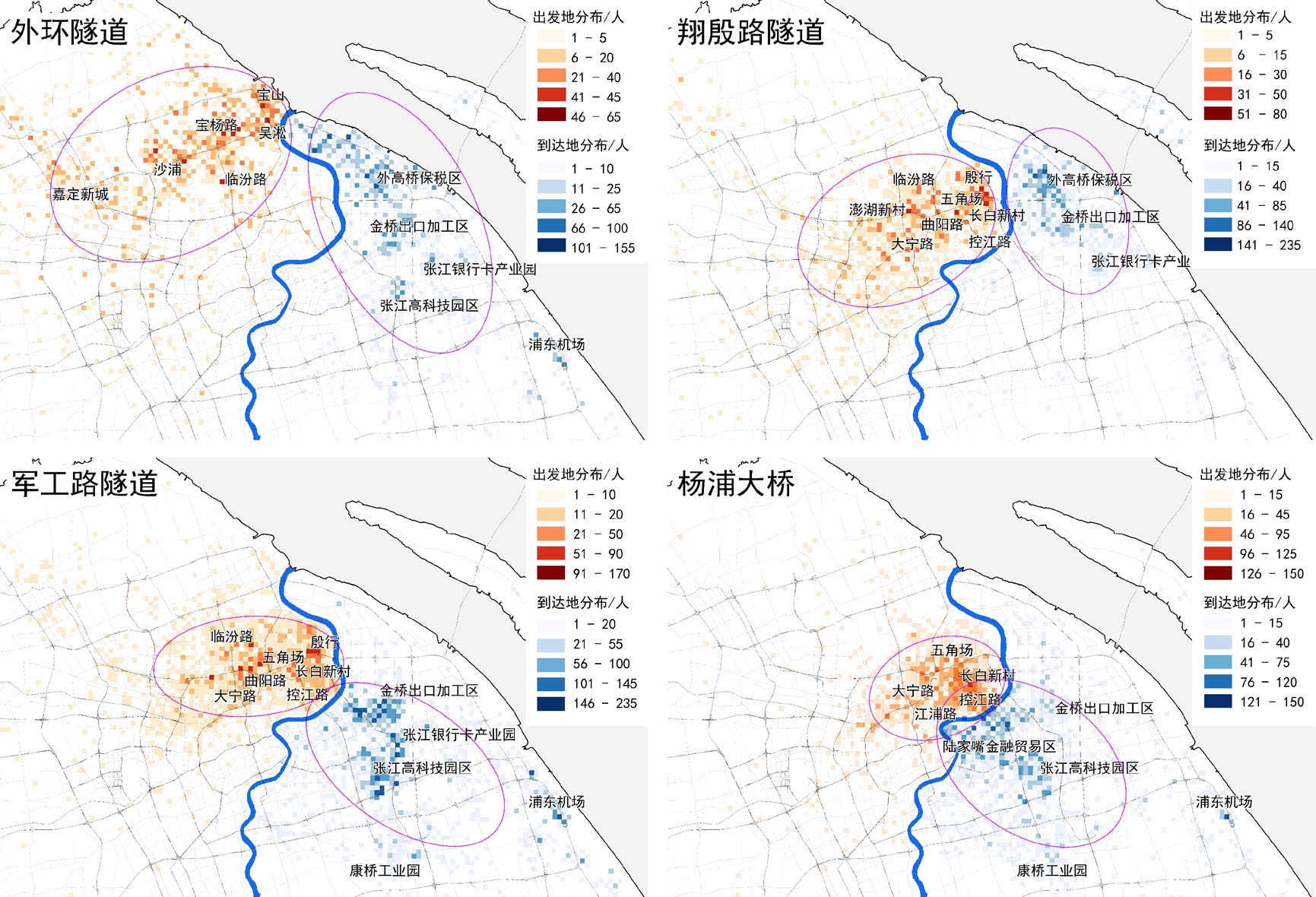
- Area: Focused on Shanghai’s primary cross-river tunnel and bridge systems.
- Data: High-resolution mobile signaling/GPS big data are used to invert and calibrate the actual behavioral parameters (μ, σ) of traffic pulses.
Core Conclusions Link to heading
Mechanism Finding Link to heading
A many-to-many coupling exists between tunnels and functional areas: each tunnel is influenced by multiple areas, and each area affects flows across multiple tunnels.
Optimization Effect Link to heading
Total Flow Curves (Before vs. After) Link to heading
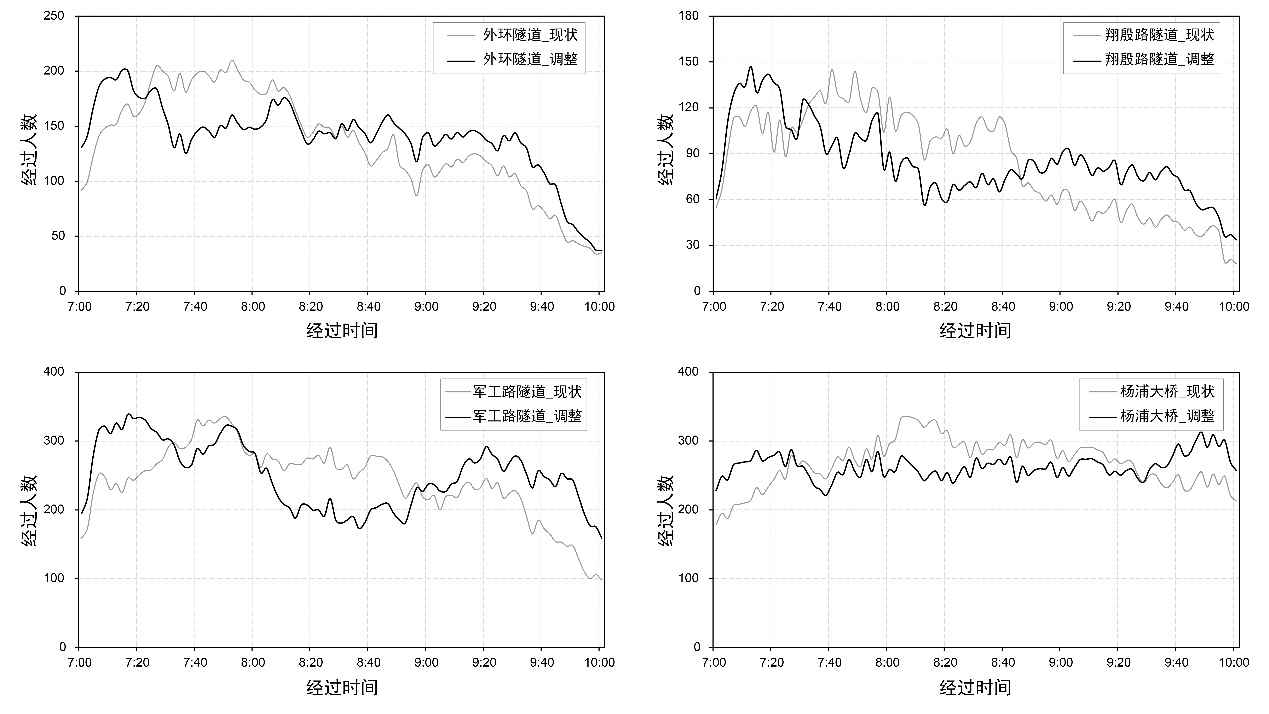
Under the 20-minute adjustment scheme, flow balance improves markedly: standard deviations decline across corridors, yielding smoother and more even profiles—Outer Ring Tunnel 46.9→33.8 (−27.93%), Xiangyin Road Tunnel 32.3→25.2 (−21.98%), Jungong Road Tunnel 53.9→44.0 (−18.37%), and Yangpu Bridge 34.6→26.0 (−24.86%).
System Travel Time Comparison Link to heading
The 20-minute adjustment scheme markedly reduces total system travel time, yielding ~1.12 minutes saved per person. By corridor: Outer Ring Tunnel ~1.22 min, Yangpu Bridge ~1.09 min, Xiangyin Road Tunnel ~0.96 min, and Jungong Road Tunnel ~0.80 min—mirroring the reduction in variability across corridors.